
Custom Nylon Bags Wholesale
Custom nylon bags manufactured for travel, retail, sports, outdoor, promotional, storage, and everyday carry applications.
Choose the fabric weight, weave, coating, compartments, carrying system, hardware, and branding according to the bag’s intended use.
Lightweight Materials · Custom Construction · Functional Details · Factory-Direct Supply
Nylon Bags Made for Different Uses


Your Custom Nylon Bag Manufacturing Partner
Nylon is valued for its strength-to-weight balance, flexibility, and abrasion resistance, but the fabric alone does not determine the performance of a finished bag. We coordinate the fabric, weave, coating, lining, compartments, webbing, hardware, and reinforcement as one complete specification based on what the bag needs to carry and how it will be used.
Nylon Fabrics for Different Applications
Select lightweight nylon for foldable and promotional bags, ripstop constructions for products exposed to tearing, or heavier woven nylon for travel and utility applications.
Purpose-Built Bag Construction
Develop custom dimensions, compartments, openings, pockets, linings, padding, closures, and carrying systems around the intended contents.
Coating and Finish Options
PU, TPU, and other backing or surface treatments can be considered according to the required hand feel, moisture resistance, structure, appearance, and target cost.
Load-Based Reinforcement
Handle attachments, shoulder-strap anchors, zipper ends, base panels, and other high-stress areas can be reinforced according to the expected carrying load.
Custom Branding and Private Labeling
Add screen printing, heat transfer graphics, embroidery, woven labels, rubber patches, zipper pullers, packaging, and other branded details.
Build Your Nylon Bag Around Its Actual Use

Select the Right Nylon Fabric and Finish
Not every nylon fabric provides the same weight, texture, strength, or appearance. The correct specification depends on the bag size, expected load, frequency of use, required flexibility, and target market.
Lightweight nylon works well for foldable totes, drawstring bags, inner linings, and compact organizers. Medium-weight fabrics provide a practical balance for backpacks, travel organizers, and sports bags, while heavier nylon constructions can be used in reinforced luggage, equipment bags, and demanding utility products.
Denier is only one part of the specification. Fiber type, yarn quality, weave, fabric density, coating, and seam construction must also be evaluated.
Lightweight Nylon · Ripstop Nylon · Oxford Weave · Ballistic-Style Weave · PU or TPU Coating
Design the Structure Around What the Bag Carries
A lightweight fabric does not mean the bag needs to be simple. Nylon can be combined with linings, padding, dividers, mesh pockets, compression straps, reinforced bases, and different closure systems to create highly functional products.
The internal construction should begin with the contents. A cosmetic bag may need wipe-clean lining and small pockets, while a travel or sports bag may require a wide opening, shoe compartment, padded shoulder strap, and reinforced base.
Instead of adding features individually, we develop the opening, organization, support, and carrying system as one coordinated structure.
Custom Compartments · Padded Panels · Mesh Pockets · Reinforced Base · Multiple Closures

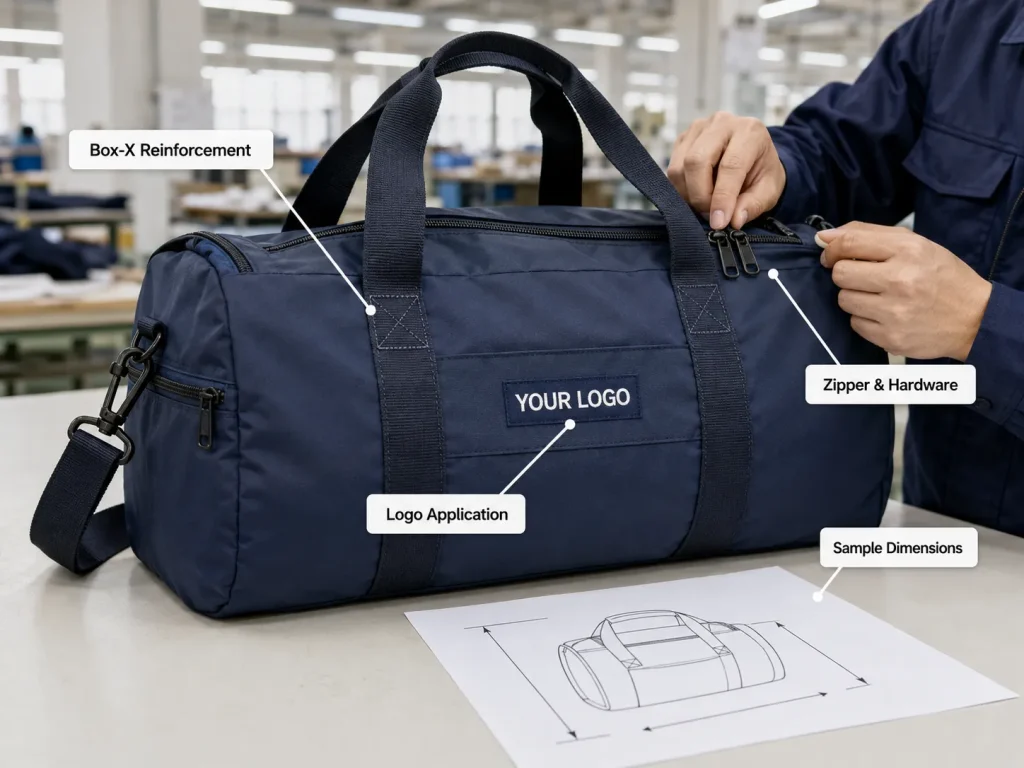
Reinforce, Brand, and Sample the Complete Bag
The load capacity of a nylon bag depends on more than the tensile strength of its fabric. Webbing width, attachment length, seam position, stitching pattern, hardware, and base construction all affect how force travels through the finished bag.
Branding should also be matched to the fabric surface. Screen printing works well for simpler graphics, heat transfer supports detailed multicolor artwork, and embroidery or custom patches can create a more dimensional finish.
Before bulk production, a physical sample should be checked as a complete product—including its dimensions, compartments, straps, hardware, logo placement, zipper movement, stitching, and loaded shape.
Load-Based Reinforcement · Custom Branding · Hardware Review · Complete Sample Approval
How ecobagfactory Brings Your Bags to Life
Certified Quality You Can Count On
Every bag we produce meets international quality and compliance standards — so you can source with confidence.
Why Nylon Is Used for Lightweight Functional Bags
Nylon is a synthetic polyamide valued for its strength, flexibility, abrasion resistance, and relatively low weight. These characteristics make it suitable for bags that need to be carried, folded, packed, compressed, or used repeatedly.
It is commonly used in travel bags, backpacks, sports bags, drawstring bags, cosmetic bags, organizers, foldable shopping bags, outdoor accessories, and other functional products.
However, “nylon bag” does not describe one fixed material specification. Two fabrics labeled with the same denier may perform differently because of differences in yarn quality, weave, fabric density, finishing, and coating.
The finished bag must therefore be evaluated as a complete construction rather than judged only by the material name.
How to Choose a Nylon Fabric for Bag Manufacturing
Fabric selection should begin with several practical questions:
- What will the bag carry?
- What is its approximate loaded weight?
- Does it need to fold into a compact size?
- Will it be exposed to frequent rubbing or outdoor use?
- Does it require a soft or structured shape?
- Is resistance to splashes or light rain required?
- Does the product need printing, embroidery, or patches?
Lightweight nylon is generally appropriate for foldable, lightly loaded, or internally supported products. Medium-weight fabrics provide more body while retaining flexibility. Heavier woven nylon can offer greater abrasion resistance and structure, although it also increases the finished weight and cost.
A higher denier does not automatically guarantee a stronger finished bag. Seam construction, strap reinforcement, hardware, and panel design remain critical.
Plain Weave, Ripstop, Oxford, and Ballistic-Style Nylon
Plain-Weave Nylon
A smooth and relatively lightweight construction commonly used for linings, drawstring bags, pouches, foldable totes, and compact organizers.
Ripstop Nylon
Ripstop fabric includes thicker reinforcement yarns woven into a visible grid. The construction is designed to help limit the spread of small tears, making it useful for lightweight outdoor, travel, and storage products.
Ripstop does not mean the fabric is impossible to tear.
Nylon Oxford
Oxford refers to a woven construction rather than a specific fiber. Nylon Oxford can provide a practical balance of flexibility, texture, and durability for backpacks, travel bags, and utility products.
Ballistic-Style Nylon
A dense basket-weave construction used where a substantial texture and improved resistance to abrasion are required. The term should be supported by the actual material specification rather than used as a general marketing label for any thick nylon.
Are Nylon Bags Waterproof?
An ordinary nylon bag should not automatically be described as waterproof.
The nylon fabric may be treated or backed with PU, TPU, or another coating to improve resistance to moisture. However, water may still enter through:
- Sewn seams
- Needle holes
- Zippers
- Openings
- Unsealed panel joints
A water-resistant bag can handle light rain or occasional splashes depending on its construction. A genuinely waterproof product normally requires suitable coated fabric, seam sealing or welding, protected closures, and a design developed specifically to prevent water ingress.
For this reason, the required performance should be confirmed before the fabric and construction are selected.
Nylon or Polyester: Which Material Should You Choose?
Nylon and polyester are both widely used for functional bags, but neither is automatically the better choice for every project.
Nylon is often selected when the buyer wants a lightweight material with good flexibility and abrasion resistance. Polyester is commonly chosen for its dimensional stability, colorfastness, broad specification availability, and cost efficiency.
The final choice should consider:
- Intended use
- Required appearance
- Fabric weight
- Abrasion exposure
- Moisture conditions
- Branding process
- Target cost
- Required testing or compliance
Material samples should be compared using the actual specifications rather than relying only on the fiber name.
Perguntas frequentes
What types of nylon bags can you manufacture?
We can develop nylon tote bags, drawstring bags, backpacks, duffel bags, travel bags, waist bags, cosmetic bags, shoe bags, storage bags, cooler bags, foldable shopping bags, and other custom constructions.
What information do you need for a quotation?
Please provide the bag type, dimensions, quantity, intended contents, approximate load, preferred material, logo artwork, functional requirements, and delivery destination. Reference photos, drawings, or physical samples are also helpful.
What does denier mean in nylon fabric?
Denier is a unit related to the mass of the yarn. It can help indicate whether a fabric uses finer or heavier yarns, but it does not independently determine fabric strength or quality.
Weave, density, yarn quality, coating, and finished construction must also be considered.
What is ripstop nylon?
Ripstop nylon incorporates reinforced yarns in a grid pattern to help restrict the spread of small tears. It is commonly used for lightweight travel, outdoor, storage, and foldable products.
Can nylon bags be waterproof?
Coated nylon can be water-resistant, but ordinary sewing leaves needle holes and seams through which water may enter. Waterproof performance requires additional material and construction measures.
Can you use recycled nylon?
Recycled nylon options may be available depending on the required fabric specification, color, quantity, certification, and supply availability. These requirements should be confirmed before sampling.
Can I receive a sample before mass production?
Yes. A physical sample allows you to confirm the dimensions, capacity, print alignment, lamination, handles, stitching, and overall construction before bulk production.
Can you provide private-label packaging?
Yes. Depending on the project, options can include custom labels, hangtags, care labels, polybags, paper sleeves, inserts, and printed cartons.
Ready to Develop Your Custom Nylon Bags?
From lightweight foldable totes to structured travel, sports, and utility bags, we can develop the fabric, compartments, carrying system, hardware, reinforcement, and branding around your actual application.
Send us your bag concept, dimensions, intended contents, quantity, and delivery destination. Our team will review the construction and prepare a factory-direct quotation.
